Built for the day-to-day, not the deploy
Config-management platforms (Ansible, Puppet, Chef) make you author a DSL, a control repo and an apply step before you can touch a host; single-box panels (Webmin, Cockpit) manage one machine at a time. Sysible Controller sits in the gap: a fleet-wide console for the work a sysadmin actually does between deployments — lock an account, chase a full disk, restart a failed service, roll a repo to twenty boxes, tail a log — all as buttons.
No DSL, no apply step
Every action is a button, not a manifest. Nothing to author, lint or version before you can act on a host.
One tool, two transports
Hosts that run a persistent agent and hosts that can’t sit in the same list, behind the same buttons — not two toolchains.
Detect and remediate together
Health & Logs doesn’t just flag a critical host — the same window kills the process, restarts the service or tails the log.
A light footprint
One controller machine, one SQLite database, one systemd service. No message bus, no master/minion cluster, no external DB.
No PKI team required
Self-signed TLS, a per-fleet SSH key pair, single-use enrollment tokens and an audit log — all provisioned at install.
One mixed fleet
Package and repo actions detect dnf, yum, zypper or apt at run time, so a RHEL/SUSE/Debian fleet is one fleet.
One console, the whole fleet
Dashboard & health
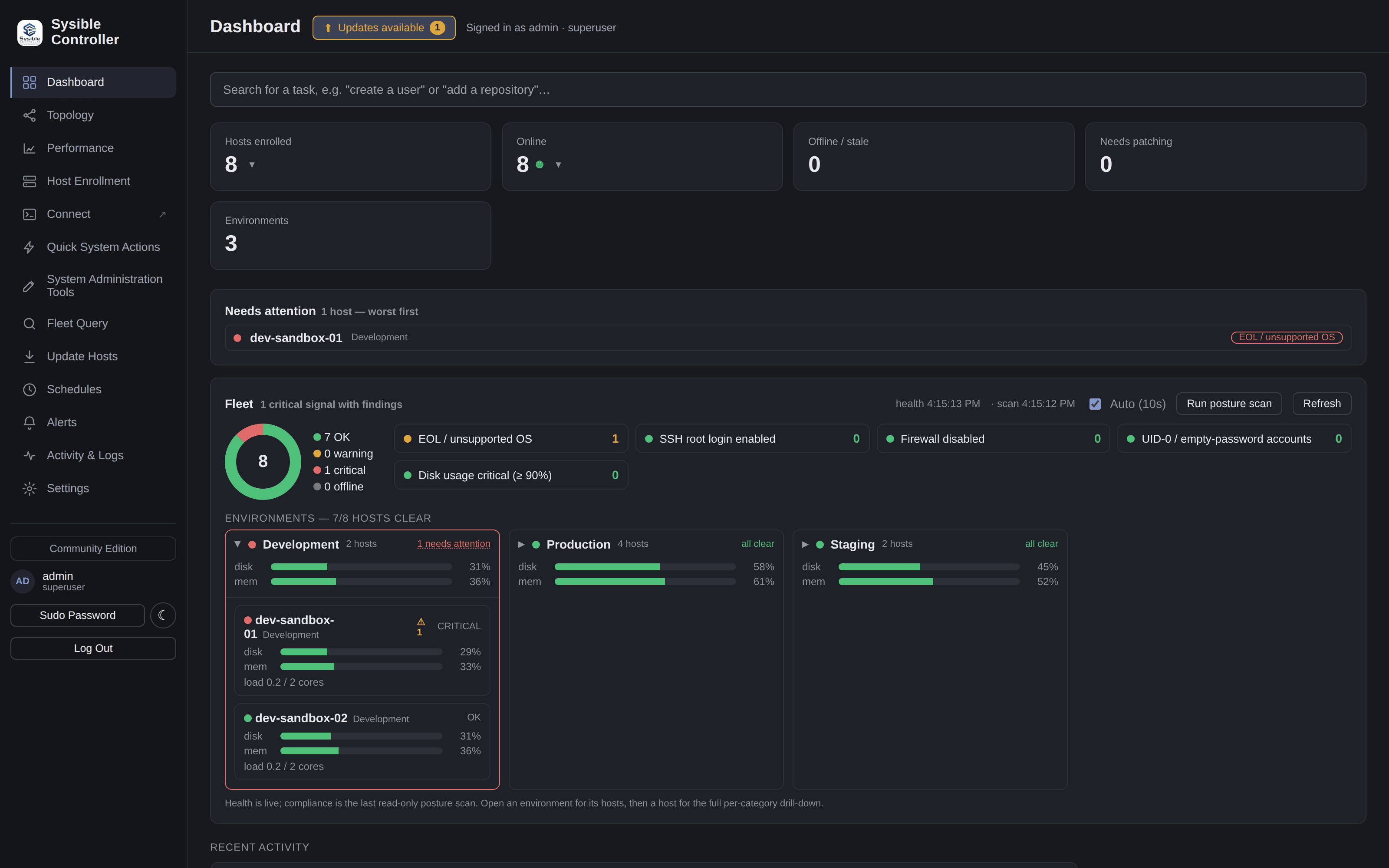
Live fleet counts, an OK/Warning/Critical health overview, and one card per environment rolled up worst-first and expandable to its hosts.
Compliance & posture
An on-demand, read-only scan surfacing high-ticket signals — reboot required, root SSH login, firewall off, MAC not enforcing, EOL OS, expiring TLS — per host.
Performance graphs
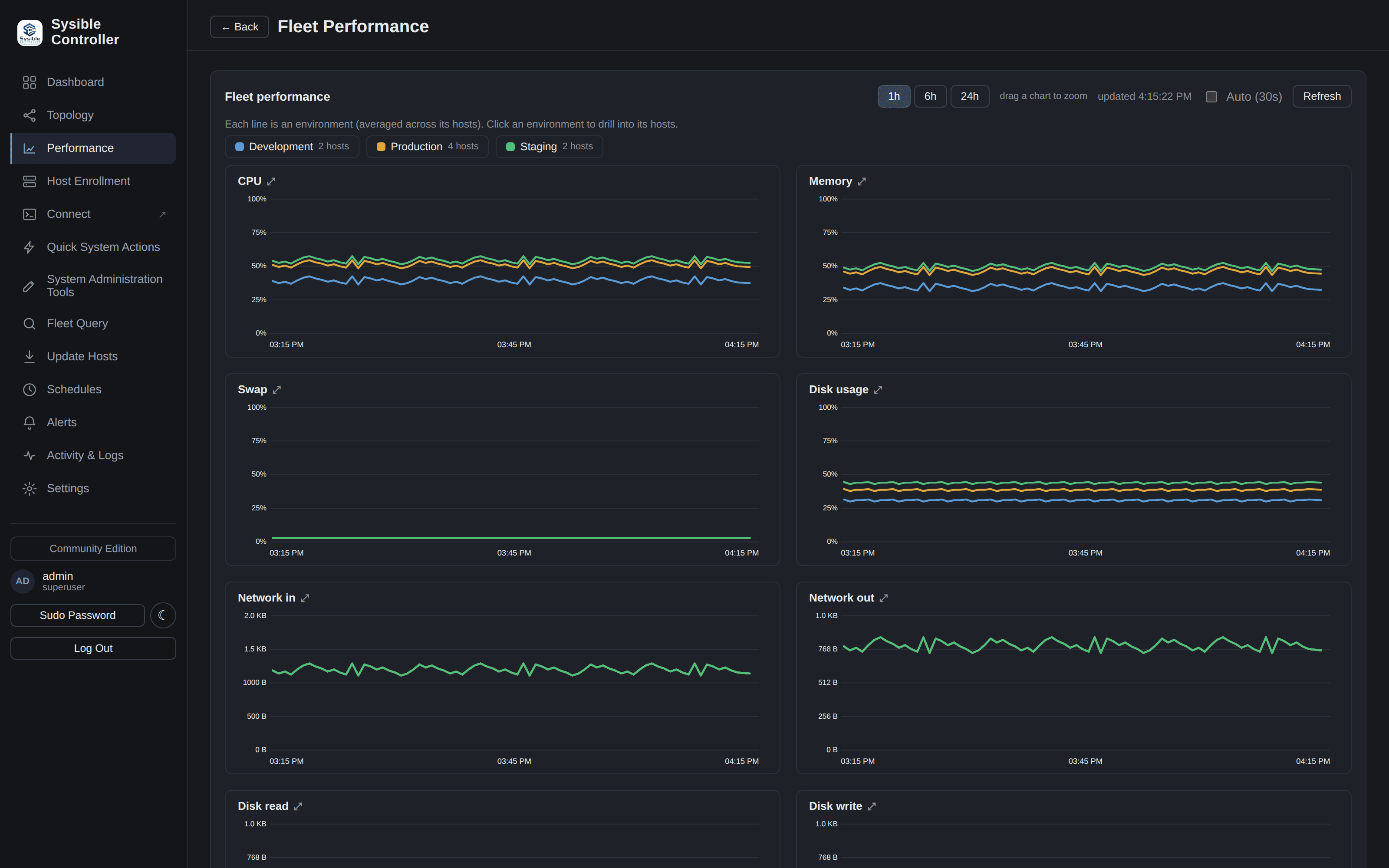
Environment-first time-series for CPU, memory, disk, network and load, fed by the agent — drill from environment to host to per-core detail.
Live terminals & files
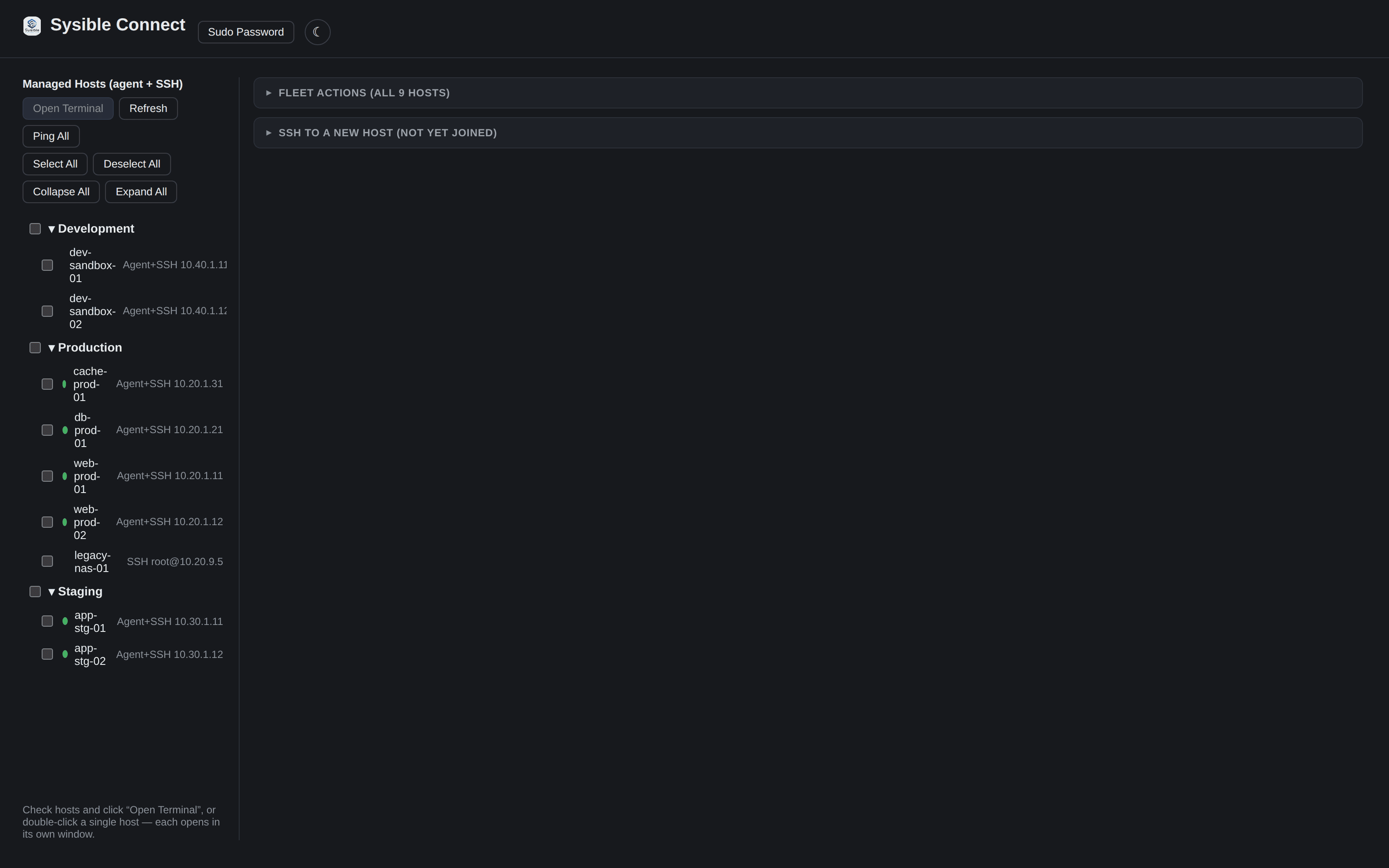
Multiple browser terminals per host, opened as your admin user — agent-hosted (works behind NAT, no inbound SSH) or a real SSH PTY — with per-host file transfer.
Host enrollment
Build single-use agent bundles or a curl one-liner, group hosts into environments, set per-host sudo policy, and disenroll cleanly.
Users & groups
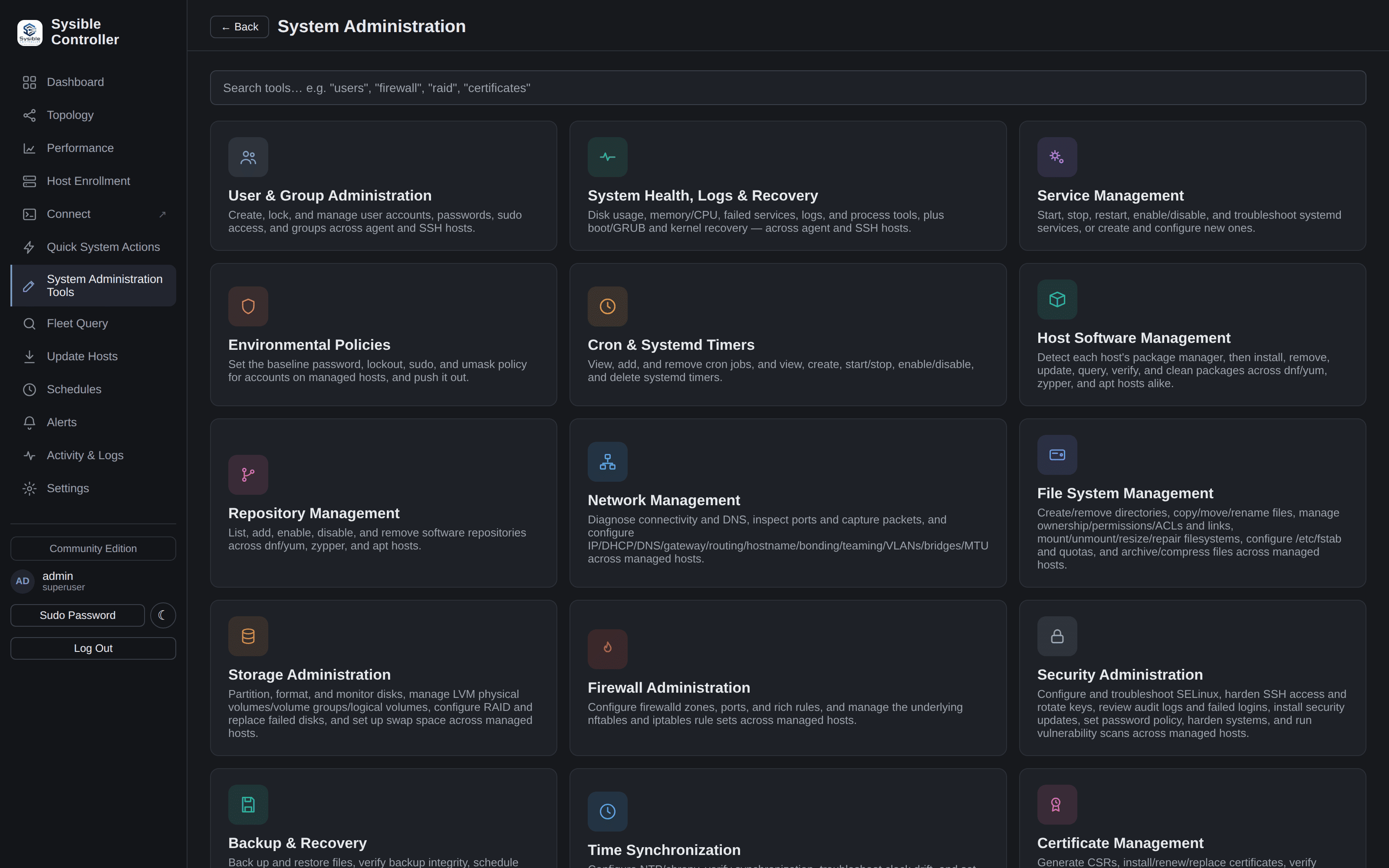
Create/lock/delete accounts, manage sudo and groups, password policy and aging, kill sessions — fleet-wide, with per-host results.
Health, logs & recovery
Disk/memory/CPU, failed services, log search, process control — plus boot-failure analysis, GRUB, kernel params and initramfs recovery.
Service management
Start/stop/enable systemd units, view logs and dependencies, one-click troubleshooting for one service or every failed one at once.
Packages & repos
Detect the package manager; install/remove/update, upload a local .deb/.rpm, and roll a repository out to the whole fleet — across dnf/yum/zypper/apt.
Networking
Connectivity and DNS diagnostics, port/socket inspection, packet capture, and IP/DNS/hostname/routing plus bonding, VLANs and bridges.
Storage & filesystems
Inspect and manage disks, partitions, mounts and filesystems across the fleet from one pane.
Firewall & hardening
Manage firewall rules and security baselines, with the posture scan flagging what needs attention.
Point-and-click, at fleet scale
Agent or SSH — the same buttons
The Sysible agent
A small Python daemon that heartbeats to the controller and polls for work. Runs as root by default, or as a locked sysible account with passwordless sudo so every action goes through a real audit trail. Its outbound channel also hosts terminals and metrics, so it works behind NAT with no inbound SSH.
Direct SSH
For hosts that shouldn’t run a persistent daemon. Hand the controller a password once; it generates and installs its own key pair and drives the host from then on — including a real interactive terminal and SFTP file transfer.
Every action runs as the administrator who triggered it — executed as that user on the target host with exactly their sudo rights, derived from their signed login token, never from anything the client can spoof. Password-sudo hosts are fully supported.
Community & Enterprise
Community Edition (CE)
The full fleet operations console — dashboard, posture, performance, live terminals, enrollment, and every System Administration tool above. Self-hosted, one machine, one database.
Enterprise Edition (EE)
Everything in CE plus D3lorean — fleet-wide host backup & point-in-time restore — and further capabilities for larger estates. Get in touch for access.
Get Controller CE
Install on a single Linux machine and manage the rest — agent or SSH.
On Sysible Workstation
# It’s baked in — just launch the installer:
install-sysible controller
Or double-click Install Sysible Software on the desktop and tick Controller.
Anywhere else
Latest Community Edition release, straight from GitHub:
Run your fleet from one console
Install Sysible Controller CE on a single Linux machine and manage the rest — agent or SSH.